Turkey's Magical Hideaways June 1 - 17, 2016
|
| |
| |
| |
| |
June 4, 2016 Explore Istanbul • Visit Hagia Sophia
|
| |
After breakfast at our hotel, our day begins with an included tour of Istanbul's Old City,
which is full of stunning palaces, mosques, and other buildings bearing the mark of its Ottoman history.
|
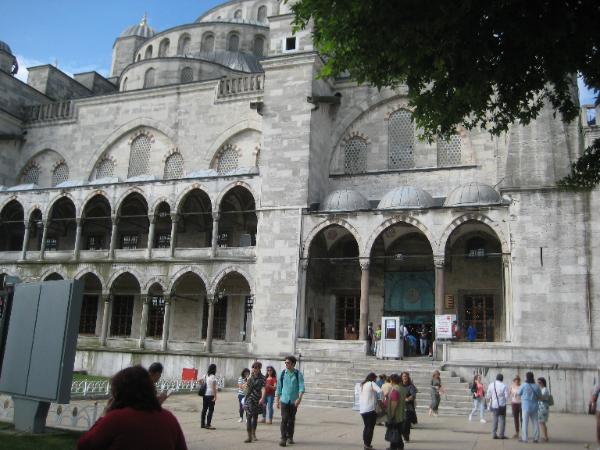
We then visit the classic Blue Mosque, so-called for the shimmering blue tiles that line its interior.
Flanked by symmetrical soaring minarets, it is one of the defining elements of the Istanbul skyline.
This classic of Ottoman architectural design was constructed under the patronage of Sultan Ahmet I, from 1609-1616.
Explore the Bazaar while touring Istanbul
|
Next we stop at Hagia Sophia, the "Church of Divine Wisdom." Completed under the Emperor Justinian in AD 537, the magnificent dome of
the Hagia Sophia was once the pre-eminent architectural wonder of the Byzantine world. The massive building was a Christian church for
almost a thousand years, until the conquest of Constantinople in 1453, when Mehmet the Conqueror claimed it for Islam. The building
served as a mosque until 1934, when the revolutionary leader and founder of the Republic, Kemal Atatürk, proclaimed it as a museum. This
impressive structure has also been designated a UNESCO World Heritage Site.
We have lunch on our own, and then board the Old Tram for a ride down Istiklal Street to the heart of Art Nouveau Istanbul. Istanbul has
many Art Nouveau buildings; several were designed by the Italian architect Raimondo Tommasso d'Aronco, the chief palace architect for
one of the last Ottoman sultans, Abudulhamid II, who ruled from 1876 to 1909. D'Aronco drew heavily from Ottoman and Islamic
architecture and art, reinterpreting them through the lens of the then-popular European Art Nouveau movement and its organic, floral
forms. The results can be seen in the many beautiful palaces and grand private homes he designed for Istanbul's government and its elite
citizens.
|
(From OAT Itinerary)
|
| |
| |
| |
| |
| |
The Sultan Ahmed (Blue) Mosque
|
| |
Even though it has been known with this name by most of the Westerners the Sultan Ahmed Mosque has never been called
by the Turks as “the Blue Mosque” throughout the history. It was called like that by Western visitors because of its famous blue tiles
from Iznik (Nicaea) that adorn the interior walls of the mosque. These are more than 21.000 in number. In those handmade tiles
along blue colour also white, green and other colours were used. However, the dominant colour when entering the mosque is obviously blue.
The floral patterns represent Earth in spring time as well as Gardens of Paradise. The beautiful decoration inside the prayer hall
and the abundant light from windows give a feeling of serenity (unlike some gloomy structures) and attract people to the mosque.
Thus, the construction process of the magnificent mosque called Blue Mosque by the Westerners, Sultan Ahmed Mosque by Turks
which is the most well-known building of the area known as Hippodrome in Byzantine period, Horse Square in Ottoman period and
called Sultan Ahmed square nowadays.
(from http://sultanahmetcami.org/sultanahmet-mosque_h11.html)
|
| |
|
|
| |
| |
| |
Blue tiles
|
|
|
| |
| |
|
|
| |
| |
Interior view, featuring the prayer area and the main dome.
|
|
|
| |
| |
| |
|
|
| |
| |
| |
| |
|
|
| |
| |
Courtyard of the mosque
|
|
|
| |
| |
| |
Sultan Ahmed Mosque
|
|
|
| |
| |
| |
|
|
| |
| |
Ablution facilities
|
|
|
| |
| |
| |
| |
| |
| |
| |
| |
| |
| |
=== Hagia Sophia ===
|
| |
Hagia Sophia, the "Church of Divine Wisdom." Completed under the Emperor Justinian in AD 537, the magnificent dome of
the Hagia Sophia was once the pre-eminent architectural wonder of the Byzantine world. The massive building was a Christian church for
almost a thousand years, until the conquest of Constantinople in 1453, when Mehmet the Conqueror claimed it for Islam. The building
served as a mosque until 1934, when the revolutionary leader and founder of the Republic, Kemal Atatürk, proclaimed it as a museum. This
impressive structure has also been designated a UNESCO World Heritage Site.
|
| |
|
|
| |
| |
|
|
| |
| |
| |
我的五個旅伴,左邊第二人是我們的導遊,
|
|
|
| |
| |
| |
Hagia Sophia
|
|
|
| |
| |
| |
|
|
| |
| |
|
|
| |
| |
|
|
| |
| |
|
|
| |
| |
Lustration urn from Pergamon
|
|
|
| |
| |
|
|
| |
| |
|
|
| |
| |
The Deësis mosaic
|
|
|
| |
| |
| |
| |
|
|
| |
| |
Fountain (Şadırvan) for ritual ablutions
|
|
|
| |
| |
|
|
| |
| |
| |
|
|
| |
| |
|
|
| |
| |
| |
| |
| |
| |
| |
| |
=== Istiklal Street ===
|
| |
|
|
| |
| |
|
|
| |
| |
| |
|
|
| |
| |
|
|
| |
| |
|
|
| |
| |
| |
走得實在太累,我們在一家咖啡館休息一下,
|
|
|
| |
導遊教我們抽土耳其煙,
|
|
|
| |
|
|
| |
| |
| |
| |
| |
| |
| |
=== Suleymantye ===
|
| |
largest mosque in Turkey
|
|
|
| |
| |
| |
| |
|
|
| |
| |
| |
| |
|
|
| |
| |
|
|
| |
| |
| |
| |
| |
|
|
| |
| |
|
|
| |
| |
| |
|
|
| |
| |
|
|
| |
| |
| |
| |
| |
|
|
| |
| |
| |
|
|
| |
| |
|
|
| |
| |
| |
| |
| |
| |
| |
| |
| |
|